
THE ART OF BEAUTIFUL IMPERFECTION
At The Carpetra, our carpets are crafted with meticulous attention to detail and refined quality standards. While the handmade process may occasionally create very subtle and exceptionally rare nuances, these are kept to an absolute minimum through careful craftsmanship, finishing, and inspection.
These quiet details are part of what makes a handmade carpet authentic—never compromising its beauty, refinement, or intended design. Because true craftsmanship is not defined by absolute uniformity, but by the considered perfection of every detail.
THE HAND BEHIND THE CRAFT
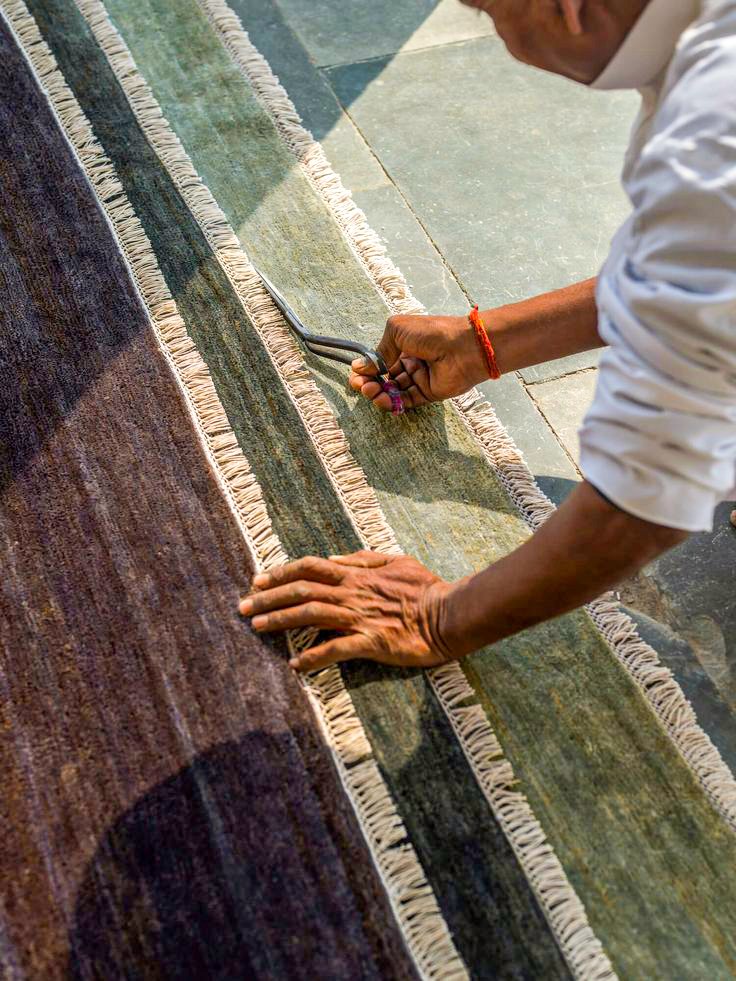
A handmade carpet carries something no machine can reproduce—the presence of the hand. Every movement, every knot, every pass of the loom and every finishing gesture is guided by an artisan. This human involvement gives the carpet its character and allows intricate designs, refined textures and bespoke details to emerge with remarkable depth. It is this relationship between artisan, material and design that makes a handmade carpet more than a floor covering. It becomes a piece of craft made specifically to exist in your space.
THE CHARACTER OF NATURAL FIBERS
The finest handmade carpets begin with materials that have a character of their own. Wool, silk, viscose, Tencel and other carefully selected fibers each respond differently to touch, light, dye and construction. Their individual qualities influence the carpet's softness, luster, texture and overall expression. Rather than forcing every fiber to behave identically, our craftsmanship works with its natural qualities—allowing the material to contribute to the final character of the carpet.
THE DEPTH OF COLOR
Color in a handmade carpet is rarely flat. The interaction between fiber, dye, pile direction, density and craftsmanship creates layers of tone that reveal themselves gradually. A color may appear deeper from one angle and softer from another, giving the surface a quiet sense of movement. This depth is one of the qualities that gives handmade carpets their sophisticated presence.
THE PLAY OF LIGHT
A handmade carpet changes subtly with its surroundings. Natural daylight, architectural lighting and the direction from which a carpet is viewed can influence how its colors and textures are perceived. The pile catches and reflects light differently across the surface, creating gentle tonal transitions throughout the day. This is why a finely crafted carpet can feel different in morning light, afternoon sun and evening illumination—while remaining unmistakably the same piece.
THE LANGUAGE OF TEXTURE
Texture is one of the first things the senses recognize. The choice of fiber, construction, pile height, density and finishing technique determines how a carpet feels beneath the hand and underfoot. From softly understated surfaces to more expressive tactile constructions, texture gives a design its physical presence. In a handmade carpet, texture is not an afterthought.
THE SCULPTED SURFACE
Some carpets are designed to be experienced not only through color, but through relief. Variations in pile height, carving, shearing and surface finishing can create subtle elevations and recesses within a design. These details introduce shadow, definition and dimension, allowing motifs to emerge from the surface with greater clarity. The result is a carpet that can feel almost architectural—where light and shadow become part of the pattern itself.
THE PRECISION OF PATTERN
Intricate handmade patterns demand patience. Every element must translate from the original design into the structure of the carpet with careful attention to proportion, placement, color and detail. Depending on the construction and density, finer patterns can require considerably greater craftsmanship and time. This is where the discipline of the artisan becomes visible.
THE DENSITY OF CRAFT
Density influences much more than appearance. The number of knots or structural elements within a carpet contributes to the definition, intricacy and character of its design. Finer constructions can allow greater detail, while different densities can intentionally be selected to achieve a particular visual or tactile expression.
THE ART OF PROPORTION
A carpet is created for a space—not simply for a measurement. Scale, dimensions, border width, pattern proportion and visual balance all influence how a carpet interacts with architecture and furniture. A successful bespoke design considers these relationships from the beginning. This is why customization extends beyond choosing a size.
The most considered carpet is one that feels as though the space was designed around it.
THE FINISHING TOUCH
The final character of a handmade carpet is shaped by what happens after its primary construction is complete. Washing, stretching, shearing, trimming, edge finishing and careful inspection refine the surface and prepare the carpet for its intended environment. These stages bring together the work of many hands and reveal the character established during construction. The finest details are often the ones least noticed at first glance.
THE FOUNDATION BENEATH
What lies beneath the surface is fundamental to the carpet's character. The foundation, backing structure, warp and weft—or the corresponding structural elements of its construction—provide the framework upon which the visible design is created. A beautifully designed surface deserves an equally considered foundation.
THE SETTLING OF THE SURFACE
A handmade carpet continues to settle into its character after it leaves the workshop. With use, the fibers gradually respond to movement, placement and everyday living. The pile finds its natural direction, the surface becomes more settled, and the relationship between fiber, light and texture can become increasingly harmonious. This is not a transformation away from the original carpet. It is the carpet becoming more naturally itself.
THE BEAUTY OF PATINA
Some materials become more compelling with time. Natural fibers can develop a softer visual character as they are lived with, cared for and exposed to their environment. Subtle changes in surface, tone and texture can contribute to a sense of depth that cannot be manufactured overnight. A well-made handmade carpet is therefore not created only for its first impression. It is created with the possibility of becoming more beautiful through years of living.
THE LIFE OF A CARPET
A luxury carpet is ultimately made to be lived with. It encounters footsteps, changing light, furniture, seasons and the rhythms of everyday life. With appropriate care, its materials and craftsmanship can continue to express their character for years, allowing the carpet to become connected to the space it inhabits. Over time, it can move beyond being an interior element and become part of the story of a home, hospitality space or architectural project.
THE INDIVIDUALITY OF EACH PIECE
No two handmade carpets are ever entirely alike. Even when produced from the same design, material and specifications, the human process and natural character of the fibers give each piece its own expression. This individuality is not a departure from precision—it is the signature of authentic craftsmanship.
For us, bespoke means more than creating a carpet to a particular size. It means creating something whose material, proportion, texture, color and craftsmanship are considered specifically for its intended space. That is the quiet distinction of something made by hand.
Crafted Beyond Expectation
At The Carpetra, every carpet is created with an uncompromising attention to detail—from the selection of materials to the final finishing and inspection. Our approach brings together experienced craftsmanship, refined design, and carefully controlled production to create carpets worthy of the most considered interiors.
For designers, architects, and discerning spaces, this means confidence in every specification, every detail, and every finish. We work to keep the possibility of visible handmade nuances exceptionally rare and minimal, while preserving the character that makes genuine craftsmanship so distinctive.
Our carpets are not made to simply fill a floor. They are conceived as individual expressions of design, material, and craft—created to complement architecture and remain distinctive long after they are placed.